Most documentation does not fail at launch.
It fails quietly. Weeks later. When a reader clicks a link that goes nowhere. When a procedure ends without telling them what to do next. When a page describes a product that shipped six months ago. Nobody filed a bug report. Nobody sent an email. The reader just closed the tab.
That is how documentation dies. Not with a complaint. With silence.
Earlier in my practice, I was working on a product documentation project. Paying close attention to information accuracy, editing and re-editing ruthlessly. Every sentence earned its place. Every technical term was defined. Every procedure was tested before it was written.
And then someone clicked a link. It went nowhere.
One broken link. That was all it took to push an otherwise solid piece of documentation into isolation. Not bad writing. Not inaccurate information. Not poor structure. A single broken connection, and the reader had nowhere to go next.
That experience forced a question I had not asked before: what actually makes documentation great? Not good. Not accurate. Not well-formatted. Great.
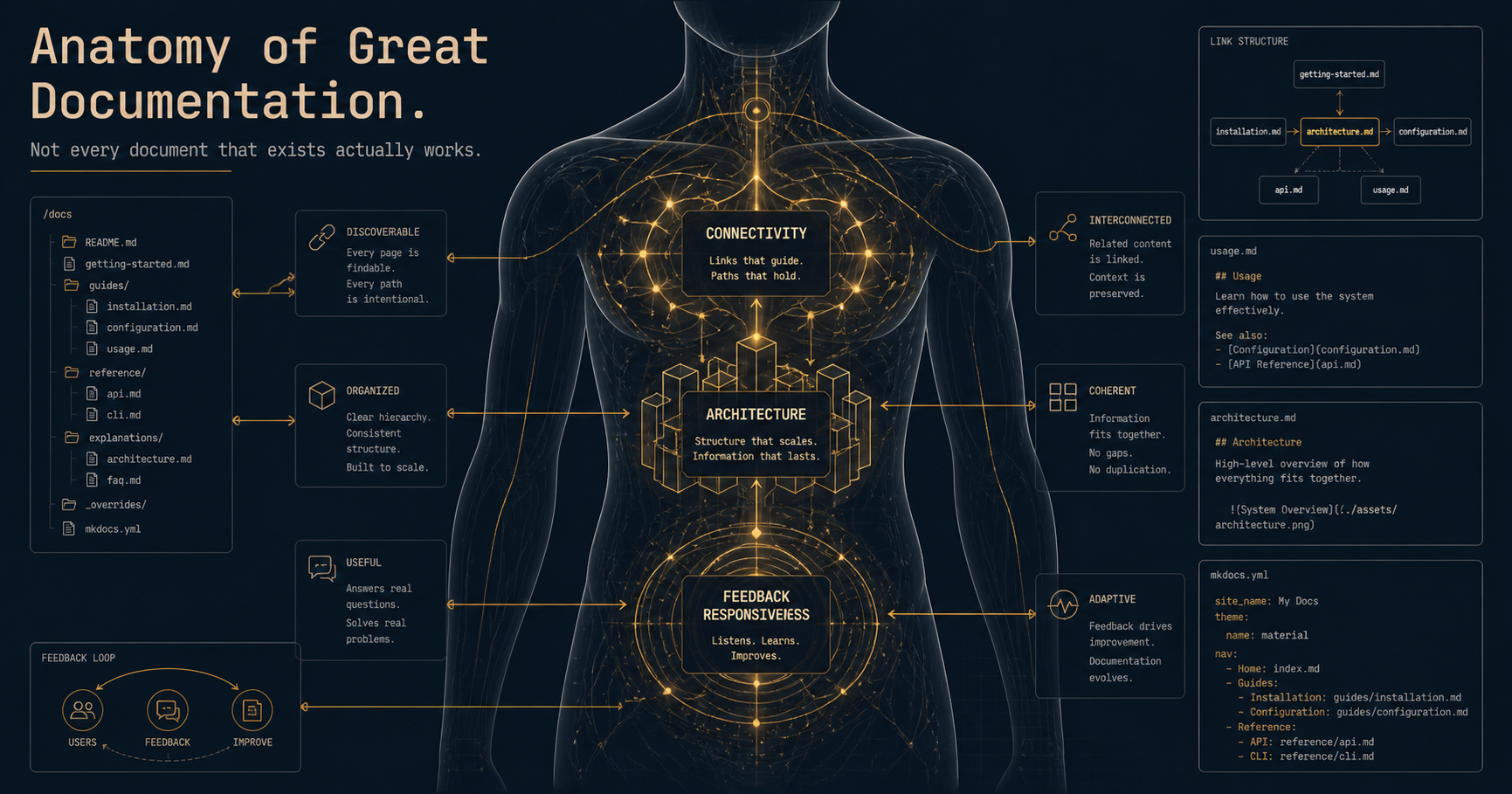
The answer is not what most technical writers expect. It is not a writing standard. It is an architectural one. And it shows up consistently in the same three places: Connectivity, Architecture, and Feedback Responsiveness, in that order, because that is the order in which most documentation systems fail.
Element 1: Connectivity
There is a version of documentation that is technically correct in every sentence and still completely useless. It answers the question the reader asked, but does not anticipate the question they are about to ask. It defines the term, but does not link to where the term is used. It explains the procedure, but ends without telling the reader where to go next.
This documentation exists. It does not work.
Documentation that actually works is connected: connected to other pages, connected to the product it describes, connected to the reader’s next question before they have to ask it. Think about the last time you used documentation that felt effortless. You probably did not notice the writing. You did not notice the formatting. What you noticed was that every time you needed the next piece of information, it was already there. That is connectivity in action. It is invisible when it works.
Now think about documentation that frustrated you: the broken link, the reference to a page that no longer exists, the procedure that ended with no next step. None of those were writing problems. All of them were connectivity problems.
Great documentation is not the sum of its well-written parts. It is the quality of its connections.
Connectivity is the first thing that breaks when documentation is treated as a writing task rather than a systems task. The fix is rarely more careful editing. It is automation: a GitHub Actions workflow that checks every link on every push and fails the build if any are broken catches what a careful editor misses every time.
Element 2: Architecture
If connectivity is about how pages relate to each other, architecture is about how the documentation system as a whole reflects, or fails to reflect, the product it documents.
Most technical writers are trained to handle visible threats: poor grammar, wrong terminology, structural errors. The real threat hides in plain sight. Which pages exist and which do not. How navigation is structured. What the entry points are and where they lead. Whether the documentation reflects the current version of the product or the version that shipped eighteen months ago.
These decisions are rarely made deliberately. They accumulate. A page is added here. A section deprecated there. A nav item renamed but not updated elsewhere. Over time, the documentation develops invisible fault lines: places where the structure no longer reflects reality, where readers fall through gaps that the writer never saw because the writer always knew the way.
Architecture problems do not show up in a grammar check. They show up when a reader hits a dead end and closes the tab. They show up in support tickets that reference the same documentation page three months running. They show up when a developer onboards and tells you the docs do not match the product.
A document can be technically perfect and architecturally broken. When that happens, the writing is not what failed. The system failed. The technical writer’s job is not just to write accurately at launch. It is to maintain a system that stays accurate as the product evolves.
Element 3: Feedback Responsiveness
Feedback Responsiveness means the documentation system actively collects signal from real readers and uses it to improve. Not a quarterly review. Not a ticket when something breaks. A structural part of how documentation is maintained.
Here is where the most experienced technical writers quietly undermine their own best work. They assume they know what good documentation looks like. That assumption, built from years of experience, style guides, frameworks, and professional instinct, creates a problem that is almost invisible from the inside. When you already know what good looks like, you stop asking whether it works.
The writer sees a flaw. The reader sees a door.
Most technical writers fix the flaw before asking whether it was a flaw at all. They edit toward correctness and away from connection. Real documentation quality is not determined at the writing stage. It is determined at the reading stage.
The only way to know what happens at the reading stage is to build feedback into the process. Ask readers what confused them. Track which pages have the highest exit rates. Notice which support tickets reference the same documentation page repeatedly. The signal is always there. Most writers are just not looking for it.
Pick any page in your current documentation. Ask four questions:
- If a reader lands on this page from a search engine and clicks every link, where do they end up?
- Does every procedure on this page reflect how the product actually works today?
- When did you last ask a real reader what confused them on this page?
- Does this page have a clear owner whose name you can identify immediately?
If any link goes nowhere, you have found a connectivity failure. If any content describes outdated behaviour, you have found an architecture failure. If you have never asked a real reader about this page, you have found a feedback failure.
The full anatomy
Great documentation is built on three elements, maintained deliberately and continuously:
Every page knows where it leads and every link goes somewhere that serves the reader’s next question.
The documentation system reflects the current state of the product, updated not just at launch but continuously as the product evolves.
The writer actively seeks signal from real readers rather than assuming experience is enough to know what works.
Remove any one of these and the documentation still exists. It may even look good. But it will not work the way it needs to.
The broken link that opened this post was a connectivity failure. But it taught me something about all three elements. I had the writing right. I had the accuracy right. What I had not built was a system for maintaining what I had written.
That is the anatomy. It is not something you build once at launch. It is something you maintain every time the product changes, every time a reader hits a dead end, and every time you are tempted to edit the prose instead of checking the connections.
Discussion