Every sprint ships. Your docs don’t keep up. Your users pay for it: in confusion, in support tickets, in churn. I build documentation systems that hold up as your product grows.

Documentation is a product surface.
Treat it like one.
Three things that are true about my work and can be verified right now. Not estimates. Not projections. Facts.
0
Publicly accessible portfolio pieces
Every piece is version-controlled, live, and readable right now. Not a PDF. Not a screenshot. Documentation you can evaluate the same way a developer would encounter it.
All six available at douglasebhoman.com/work0+
Years building documentation systems
Not writing. Systems. The difference between a document that exists and documentation that holds up as the product evolves, the team changes, and the sprints keep shipping.
API docs · Docs-as-Code · DevTools · SaaS0
Working days to audit delivery
You send me the link. I send you the report. A written diagnosis, prioritised action plan, and 30-minute walkthrough. Fixed fee. No scope creep.
€300 flat · Currently availableMost documentation is written for the person who built the product.
Not the person who has to use it.
That distinction sounds small. It isn’t. When an engineer documents a feature, they document what it does. What they forget, because they cannot unknow it, is that the reader arrives without that context. The reader does not need a description of the feature. They need a map from their problem to the solution.
I came to technical writing through creative writing. That is not a detour. Fiction trained me to analyse an audience's mental state before writing a single word, to understand what they are carrying, what they already know, and where they are likely to get lost. That is not a writing skill. It is an information architecture skill. And it is exactly what most technical documentation is missing.
What drives me is not passion. It is responsibility: to be the advocate for the users who are quietly suffering the consequences of documentation nobody designed with them in mind.
I write fiction in Prague in the evenings, the same discipline as documentation, at its core: imagine the reader you have never met, understand what they need to know, and build something they can move through without getting lost.
01 — Principle
Empathy before architecture
Knowing the reader’s pain point is not a soft skill. It is the baseline every documentation decision should be built on.
02 — Principle
Structure is a reader service
Findability is an architecture problem, not a writing problem. Good structure means the reader never has to guess what comes next.
03 — Principle
Narrative is infrastructure
Documentation written with narrative logic gets read. Documentation written without it gets skimmed, misunderstood, and ignored.
Six questions. Two minutes. A specific diagnosis of where your documentation system is failing and what it is costing you right now.
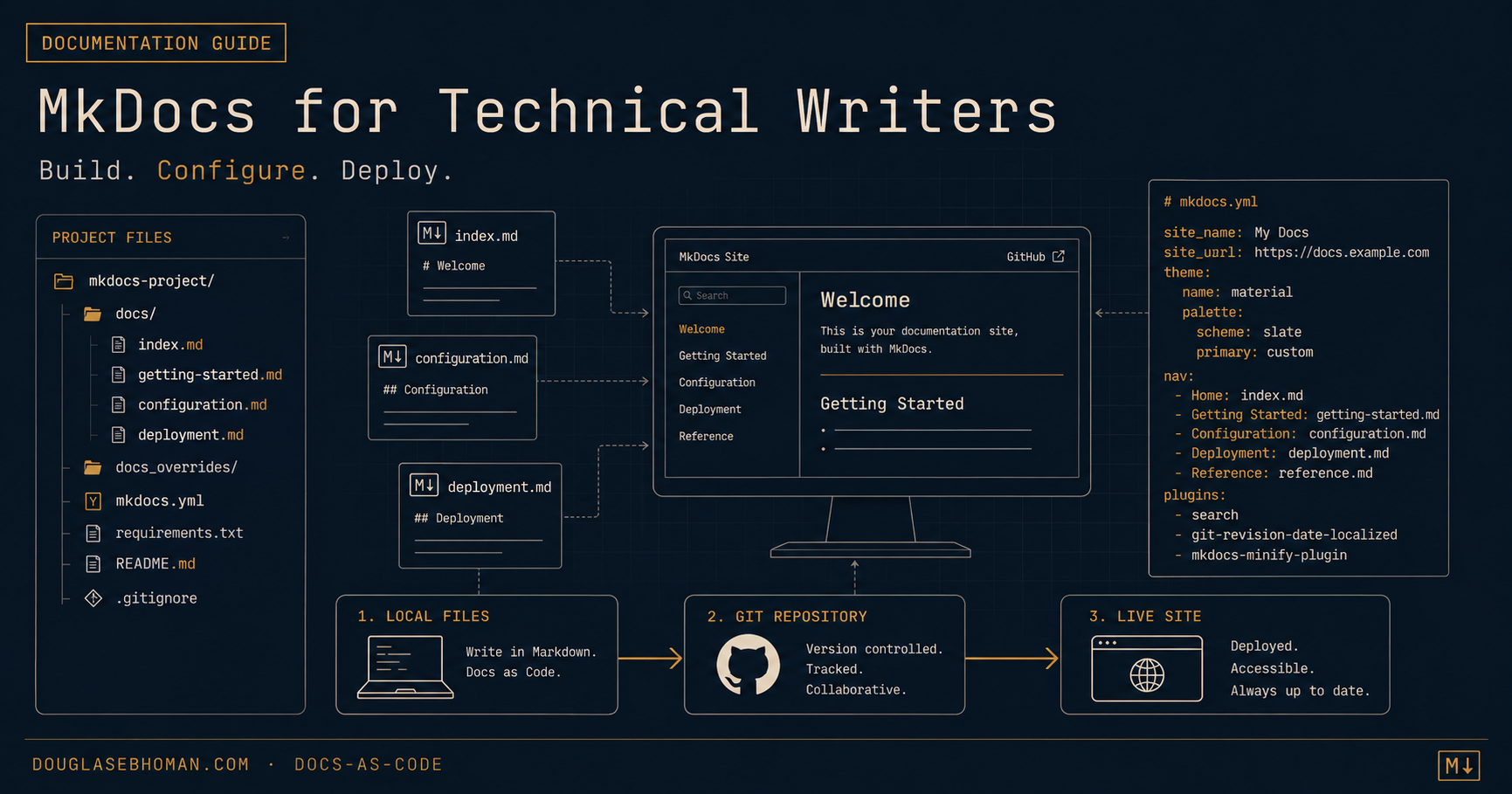
MkDocs for Technical Writers
The problem
Writers adopting Docs-as-Code had no guide that didn’t require a developer alongside them.
What I built
A complete guide from installation through production deployment, written for writers not engineers.
Result: Removes the developer dependency from the onboarding process entirely.
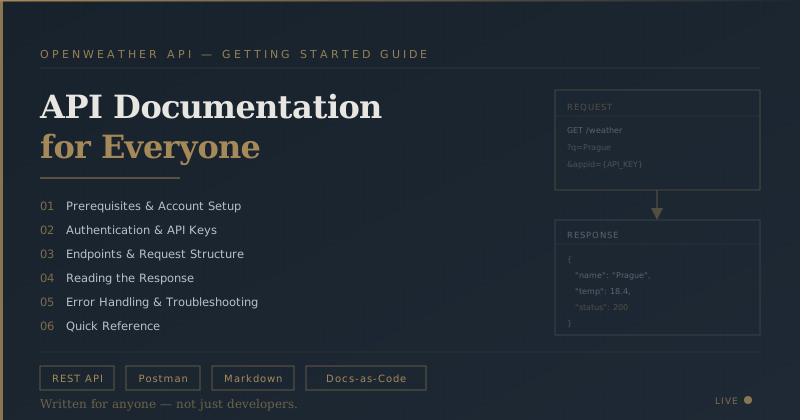
OpenWeather API — Getting Started Guide
The problem
Engineers had no clear path from authentication to a working first API call.
What I built
End-to-end docs covering auth, endpoints, parameters, and response interpretation.
Result: Eliminates the most common first-session failure points for new API users.
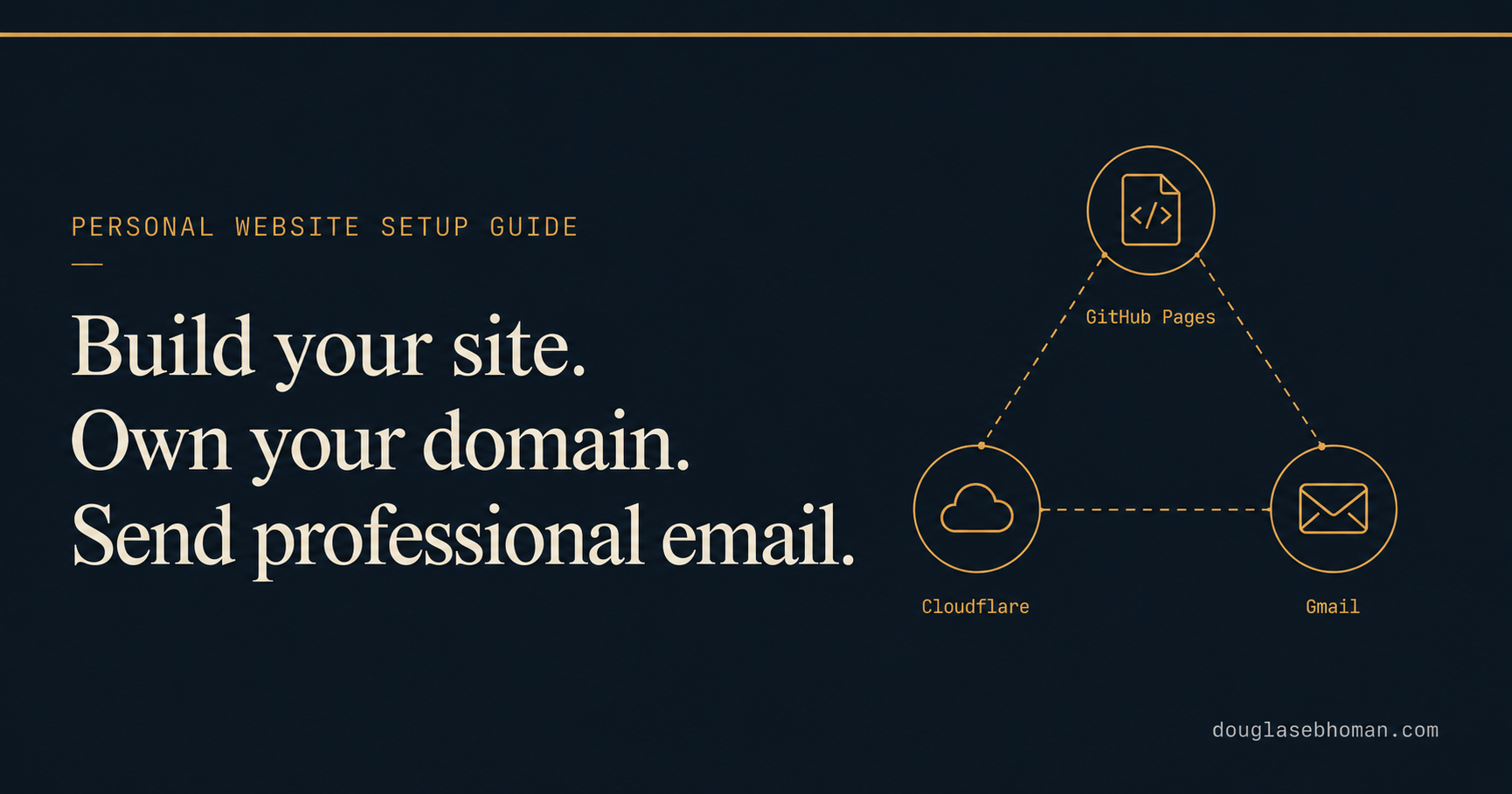
Personal Website Setup Guide
The problem
GitHub Pages, DNS, HTTPS, and email setup had no single coherent reference.
What I built
End-to-end docs covering every component, with troubleshooting for every common failure point.
Result: Collapses a multi-day setup process into a single navigable document.
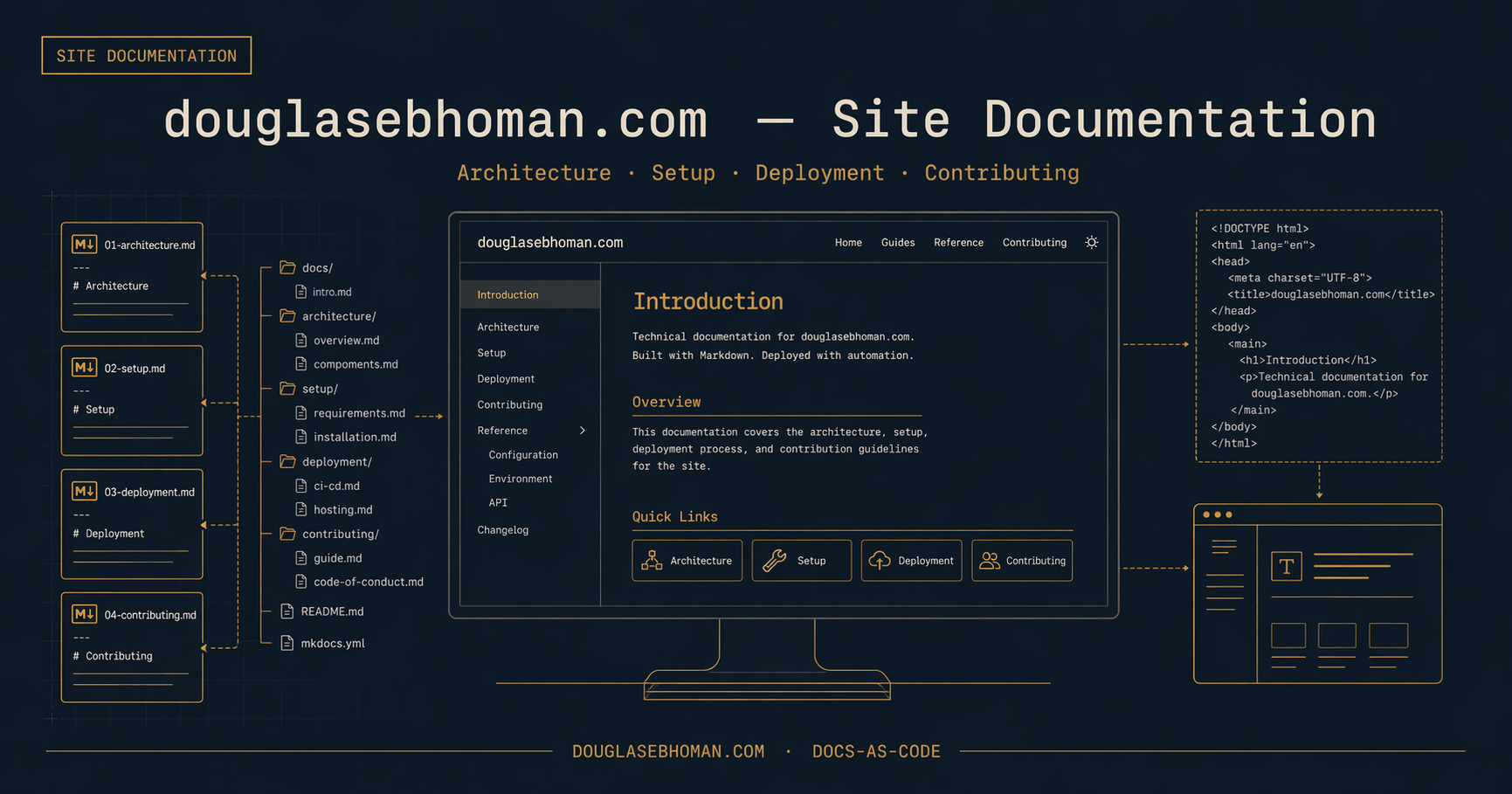
douglasebhoman.com — Site Documentation
The problem
Portfolio sites are typically undocumented black boxes, hard to maintain, impossible to hand off.
What I built
Internal-style docs: architecture, local setup, deployment pipeline, contributing guidelines.
Result: A site that documents itself, the same standard I apply to every client engagement.
The best way to evaluate a technical writer is to read their work in context. Each tab below shows a real excerpt from a real piece, structured, styled, and readable exactly as a developer would encounter it. This is the creative-technical blend in practice.
Returns the current weather for a given location. Supports lookup by city name, city ID, geographic coordinates, or ZIP code. Responses are in JSON by default.
401 Invalid API key error immediately after creating a key, wait 10 minutes and try again.| Parameter | Type | Required | Description |
|---|---|---|---|
q | string | Yes* | City name. Add country code for precision: London,uk |
appid | string | Yes | Your API key |
units | string | No | metric (°C), imperial (°F). Default: Kelvin |
curl "https://api.openweathermap.org/data/2.5/weather?q=London,uk&units=metric&appid=YOUR_API_KEY"{"weather":[{"main":"Clouds","description":"overcast clouds"}],"main":{"temp":15.2,"feels_like":14.1,"humidity":82},"wind":{"speed":5.1,"deg":200},"name":"London"}MkDocs is a static site generator for building project documentation from Markdown files. This guide takes you from installation to a live documentation site, no prior experience required.
python --version to check.Install MkDocs
pip install --upgrade mkdocsCreate a new project
mkdocs new my-project && cd my-projectStart the development server
mkdocs serveThis document describes the technical architecture of douglasebhoman.com. Written for future maintainers who need to understand how the site is structured without reverse-engineering it from source.
| Layer | Technology | Why |
|---|---|---|
| Generator | Jekyll | Supported natively by GitHub Pages. |
| Hosting | GitHub Pages | Free, reliable, deploys on git push. |
| Styles | Custom CSS | Zero dependencies. Full design control. |
| DNS | Cloudflare | Free SSL and performance caching. |
main triggers a GitHub Pages build. Deployments complete in under 60 seconds.Git is version control software originally built for code. As a technical writer, you will use it to track changes to documentation, collaborate with engineers, and publish updates without emailing files.
git pull origin main
git checkout -b docs/update-api-authentication
git add docs/authentication.md
git commit -m "docs: clarify token expiry behaviour in auth guide"Most teams know their documentation is a problem. They don’t know exactly where it’s failing or what to fix first. That’s what the audit solves. I read everything. I identify the structural failures and rank them by impact. You get a written report and a 30-minute call. No vague feedback. No generic advice. A clear, prioritised plan you can act on immediately.
Full documentation review
Every page assessed across accuracy, structure, ownership, and findability. Nothing assumed, nothing skipped.
Prioritised action plan
Every finding ranked by impact. You know exactly what to fix first, and why.
Structural recommendations
Not just what’s broken: what to build instead. Architecture, ownership model, and system logic.
30-minute walkthrough call
I walk you through every finding. You can ask questions, push back, and leave knowing exactly what happens next.
Delivered in 5 working days
You send me the link. I send you the report. Fixed timeline, fixed fee. No scope creep, no surprises.
Documentation Audit
I read your docs. You get clarity.
Fixed fee · No surprises · 5 working days
Consider this
One mis-documented API endpoint costs your team 3–5 hours of support time. The audit costs less than a single engineer’s half-day.
Audit
I review your documentation against four dimensions: accuracy, structure, ownership, and findability. You receive a written report and a 30-minute walkthrough within five working days.
You find out exactly what is broken.
Diagnose
We identify structural problems and prioritise what to fix first, and why. Every recommendation is ranked by impact, not by how easy it is to implement.
You know where to start.
Build
I design and implement the documentation system: architecture, templates, ownership model, deployment pipeline. The kind that stays accurate as your product grows.
You get a system, not a document.
Hand off
Your team owns everything. I document the system itself so you can maintain it without me. The goal is independence, not dependency.
You don’t need me forever.
“A must-read if you want to adopt Git and GitHub for product documentation.”
Douglas has nailed it with his Git and GitHub for Technical Writers series. He has a knack for writing in a simple, clear style. It is a pleasure to read. The kind of documentation that removes the barrier between the writer and the workflow.
Tejas Dandekar
Associate Director, DP&S
What this engagement delivered
Users couldn’t navigate the platform without asking for help. The documentation existed but wasn’t doing any work.
“Douglas doesn’t just write documentation. He builds clarity into the product experience itself. His ability to simplify complex systems while maintaining strategic structure significantly improved how our users interacted with our platform.”
Product Lead
Series A SaaS platform · 60-person team
→ Documentation systems engagement
They hired a writer. What they got was a systems strategist who changed how the whole team thought about documentation ownership.
“Sharp thinking. Structured execution. Documentation that actually moves the product forward. Working with Douglas felt less like hiring a writer and more like bringing in a systems strategist.”
Engineering Lead
Developer tooling company · Seed stage
→ Documentation systems engagement
They came in thinking the problem was the writing. The audit showed the problem was the system underneath it.
“We came in thinking we needed a technical writer. What we actually needed was a documentation system, and Douglas delivered exactly that. Cleaner onboarding, fewer support questions, and documentation that finally felt intentional.”
Head of Product
DevTools company · Series A
→ Documentation Audit + systems build
The pattern across every engagement
Every client arrives with a different surface problem: docs that are out of date, users who can’t find what they need, engineers who are the single source of truth. The root cause is almost always the same: documentation that was written but never designed.
The audit makes the structural problem visible. Then we fix it with a system that holds up as the product grows, not a document that starts drifting the day after it ships.
100%
of audit clients identified structural ownership failures they hadn’t named before the report
€300
fixed fee · five working days · no scope creep · no surprises
Every sprint that ships without a documentation update widens the gap. Your users are paying for it: in confusion, in support tickets, in churn nobody is measuring. The audit gives you a prioritised action plan in five working days. Specific findings. No generic advice.
Worth considering
One mis-documented API endpoint costs your engineering team 3–5 hours of support time. The audit costs less than a single engineer’s half-day. The question is not whether you can afford it — it is whether you can afford not to.
Documentation Audit — I read your docs. You get clarity.
A full review across accuracy, structure, ownership, and findability. Every finding is specific. Every recommendation is actionable.